 Blog
Boutique vs National Yacht Brokerage Service Levels
Compare boutique yacht brokerage service to national firms. See how captain-led representation, buyer and seller advocacy, and survey support differ.



Last Updated: October 17, 2026
Yacht registration vs documentation explained comes down to one question: which government keeps the record. Registration is a state function. Documentation is a federal one. Both establish legal standing for a vessel, and many owners assume they must pick one or the other. In practice, the answer depends on size, financing, and where you plan to cruise.
At Spencer Christopher Yacht and Ship, we handle these filings as part of closing on vessels out of Stuart, FL, and the difference between the two comes up in nearly every transaction. Here is the short version: state registration is a numbering and titling process administered by the state motor vehicle authority, while USCG documentation is a federal record of the vessel itself, its ownership, and its tonnage.
That distinction matters before money moves, not after.
State registration issues a registration number and decal that must be displayed on the vessel, and in most states it produces a certificate of title that proves ownership. Florida treats it as a vehicle registration, administered through the county tax collector's office.
Registration is available for vessels of essentially any size, and it is generally the simpler and less expensive path. It also ties the vessel to state sales and use tax collection at the point of registration, which is why the county office, not a federal agency, is where most owners start.
What registration does not do is create a federal record. That gap matters to lenders and to anyone cruising beyond state waters.
USCG documentation is a federal registry of the vessel maintained by the National Vessel Documentation Center. It establishes the vessel's nationality, records its ownership and tonnage, and serves as the basis for a preferred ship's mortgage.
A documented vessel carries an official number instead of a state registration number, and it does not display state numbers. Documentation is a one-time filing with a renewal cycle, unlike registration, which renews on the state's schedule.
The practical benefit is financing and title clarity. Lenders prefer documented vessels because the mortgage is recorded against the vessel in a federal system, not a state one.
National Vessel Documentation Center
The two systems overlap less than people assume. A documented vessel is exempt from state numbering, but Florida still requires it to display a validation decal if it is used on state waters, and the owner still owes Florida registration fees in that case.
Where each one applies, plainly:
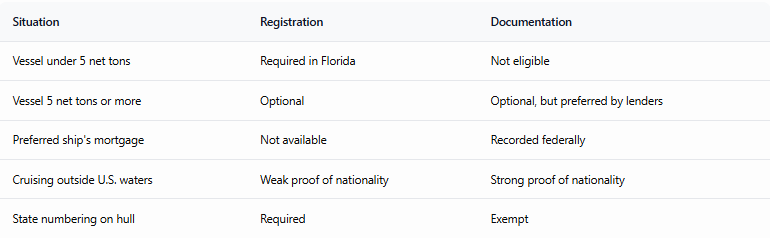
The common mistake is assuming documentation replaces registration entirely. In Florida, it does not.
Eligibility is narrower than most buyers expect. To document a vessel, it must measure at least 5 net tons, be owned entirely by a U.S. citizen or U.S. entity, and be used in a qualifying activity such as recreation or commercial service.
Ownership is the sticking point. A vessel held by a foreign entity, or by a U.S. entity with foreign ownership above the allowed threshold, cannot be documented. Chain of title must be clean and traceable, because the NVDC reviews the full ownership history, not just the current bill of sale.
Builders and closings that involve an LLC should confirm entity citizenship before the survey, not after.
Watch Out A vessel that fails the citizenship test cannot be documented, and a lender's preferred mortgage cannot be recorded against it. Confirm entity structure before you sign a purchase agreement, not at closing.
Florida vessel registration requirements are handled at the county tax collector. The owner needs a title or proof of ownership, a completed application, photo identification, and payment of registration and title fees. Vessels purchased from a dealer are typically titled and registered by the dealer at delivery.
Florida requires registration for any vessel with a motor used on state waters, and titles are issued for vessels registered in the state. Registration renews annually, and the decal must be displayed.
For buyers in Stuart, FL, the Martin County tax collector's office is the filing point, and it is also where sales tax is settled. Bring the signed title, the bill of sale, and the hull identification number.
Florida vessel registration and titling
Run this list before the closing date, not after.
Confirm the vessel's net tonnage and whether it qualifies for documentation
Verify the seller's name matches the title exactly, with no open liens
Check the hull identification number against the title and the physical hull
Confirm entity citizenship if the buyer is an LLC or corporation
Decide registration, documentation, or both, and confirm the lender's requirement
Obtain a marine survey and a title abstract before funds move
Settle state sales tax at the county office or through the closing agent
Record the preferred ship's mortgage with the NVDC if financed
A title abstract is the step buyers skip most often. It surfaces liens and prior claims that a clean-looking title can hide.
The first mistake is treating documentation as a substitute for registration. In Florida, a documented vessel used on state waters still needs the state decal and the state fees.
The second is buying a vessel in an entity that cannot be documented, then discovering the lender will not fund. Entity structure is cheap to fix before closing and expensive to fix after.
The third is skipping the title search on a private sale. A lien recorded against the vessel follows the vessel, not the seller.
The fourth is filing documentation late and cruising on an expired decal. The NVDC processes renewals on its own timeline, and a lapsed record creates problems at the dock and at the border.
Pro Tip Order the title abstract and the NVDC status check on the same day. If the two records disagree on ownership or tonnage, you want that gap visible weeks before closing, not the morning of.
The paperwork question is settled best at the survey stage, when there is still time to adjust the deal. Confirm tonnage, confirm entity citizenship, confirm the lender's requirement, and confirm the state filing path. Those four answers determine whether you register, document, or do both.
Spencer Christopher Yacht and Ship handles this work as part of closing, with an in-house closing department and brokers who hold USCG master licenses and have run these filings on vessels from center consoles to superyachts. For buyers still searching for the right vessel, our Yacht Brokerage team works the same questions into the search itself, so tonnage and entity structure are settled before an offer goes out. Getting the registration and documentation decision right before closing saves owners a season of corrections afterward.
Registration is a state function: it records the vessel with a state agency, issues registration numbers and a decal, and typically runs on a renewal cycle. Documentation is a federal function through the U.S. Coast Guard, which records the vessel as a U.S.-flagged entity with a national title and an official number. Registration proves you paid state fees and may operate locally; documentation establishes federal nationality and a recorded title chain. Many yachts end up with both, which is why the two get confused.
In practice, yes. A federally documented vessel used on Florida waters still has to satisfy state registration requirements, though the state issues a decal rather than hull numbers for a documented yacht. Buyers should confirm current requirements with the county tax collector's office before closing, because the rules and fee structure depend on how the vessel is titled and where it is kept.
Federal documentation eligibility requirements center on vessel size and ownership. Vessels of at least five net tons, wholly owned by U.S. citizens, are generally eligible to be documented. A vessel owned by a corporation or LLC must meet the citizenship tests that apply to that entity. Builders, prior title history and the vessel's use can all affect the application, so eligibility should be verified before a purchase contract is signed, not after.
Work from a yacht title and registration checklist for buyers: confirm the seller's name matches the title exactly, verify any recorded liens or mortgages are satisfied at closing, check that hull identification numbers match across documents, and confirm the vessel is not documented under a prior owner who has not been discharged. A title search through the appropriate federal or state record, plus a marine survey, protects the buyer far more than a handshake and a bill of sale.
BlogCompare boutique yacht brokerage service to national firms. See how captain-led representation, buyer and seller advocacy, and survey support differ.
 Blog
Avoid hidden mechanical costs when buying a used sportfish yacht. Use this survey, engine survey, and sea trial checklist to protect your investment.
 Blog
Learn how to finance a used sportfish yacht. Explore loan options, preapproval steps, documents needed, and what lenders evaluate.
Send them over. Every inquiry gets a substantive response within 24 hours, from a person who has read what was asked.