 Blog
Which Bahamas Marinas Suit a New Yacht Owner?
Compare Bahamas marinas for new yacht owners by slip capacity, location and facilities, and learn what to check before you choose a dock.


Last Updated: November 20, 2026
Quick Summary
Outboard vs inboard engines each suit different fishing. Outboards offer easier service access and shallower draft, while inboards typically provide a steadier, quieter ride and a cleaner transom for fishing. The right choice depends on where you fish and how much maintenance you want to handle.
Outboards have easier service access and generally allow shallower running draft.
Inboards keep the transom clear, which suits a fighting chair and stern work.
Outboards are exposed to salt spray, so corrosion control and flushing matter.
Inboards tend to be quieter with a steadier platform in a chop.
Inboards carry a deeper draft that limits how far you can run into shallow water.
Outboard vs Inboard for Fishing: Why the Engine Choice Shapes Your Day on the Water
Cockpit Space, Transom Layout and Draft in Shallow Stuart Waters
Choosing between an outboard and an inboard engine is one of the first decisions a sportfish buyer makes, and it affects far more than top speed. The engine configuration shapes how a sportfish yacht fishes, how it handles docking, and what it takes to keep running in saltwater year after year. Most guides treat the pros and cons of outboard vs inboard engines for fishing as a simple contest with one winner. That framing misses the point. The right answer depends on your fishing style, your hull, and how much time you want to spend on maintenance.
The short version: outboards generally offer easier service access and better shallow-water draft, while inboards typically offer more displacement, a quieter ride, and a cleaner transom for fishing. Both work well offshore. The details below explain where each one earns its keep and where it falls short.
These three configurations are often confused, so it helps to define them first. An outboard is a self-contained engine mounted on the transom, with the drive unit hanging off the back of the boat. An inboard sits inside the hull, with a shaft running through the bottom to a propeller. A sterndrive, sometimes called an inboard/outboard, places the engine inside the hull but moves the drive unit outside through the transom.
That distinction matters. Many buyers use "inboard" to describe a sterndrive, and the trade-offs differ. A conventional inboard keeps the transom clear and the propeller shaft low, while a sterndrive keeps the drive exposed in a way that affects deck layout and maintenance.
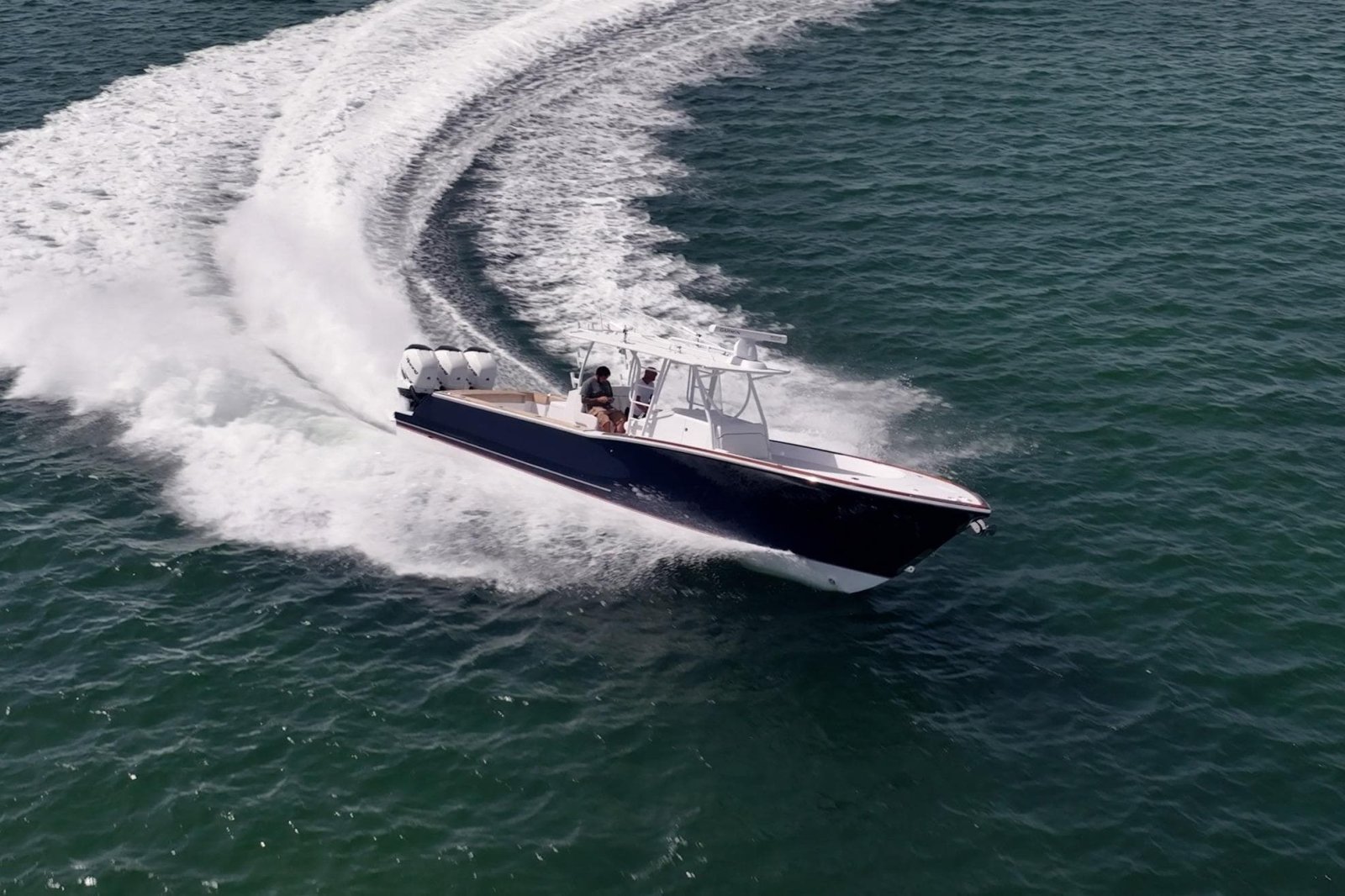
Outboards are common on fishing boats for good reasons. They are light relative to their power, which helps with a boat's performance and handling. Because the engine sits outside the hull, the interior and cockpit stay open, and the drive raises out of the water easily, which helps in shallow flats and along the Treasure Coast.
2015 SeaVee 390Z | PAIRADOX by Central Listing Broker Sam Brennan
Spencer Christopher Yacht and Ship Inc
Service is a major advantage. Outboards have fewer interconnected systems than many inboard setups, which can mean simpler diagnostics and easier access to the powerhead. Many owners can handle routine checks themselves, and the engine can be lifted or replaced without pulling the hull apart. A broker with experience in outboard-powered sportfish can also help you line up a qualified service yard before you buy, through our Yacht Brokerage practice.
The downsides are real. Outboards sit exposed to salt spray and direct sun, so corrosion control and regular flushing matter in saltwater. On larger vessels, a single outboard may not deliver enough horsepower, and multi-engine rigs add cost and transom weight. Outboards are also generally louder at idle and under power than an inboard, which some anglers notice on long days offshore.
Best for: Anglers who fish skinny water, want simple service access, and run a smaller or mid-size sportfish.
Skip if: You need a large single power plant or want the quietest possible ride.
The trade-offs for each configuration come down to a few concrete points:
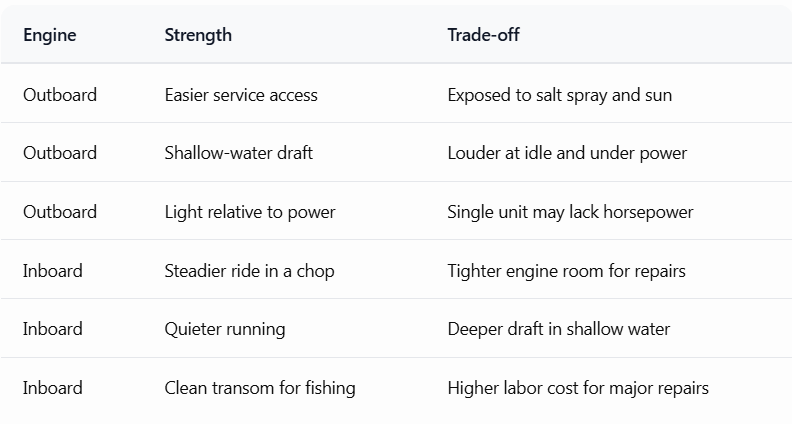
Inboard engines carry their weight low and centered in the hull. That typically gives greater displacement, a steadier platform, and a smoother ride in a chop, which is why many offshore sportfish builders favor them. Inboards also tend to be quieter, and they keep the transom uncluttered, which matters on a boat built around a fighting chair and a clear stern.
The trade-offs are access and draft. Engine rooms are tighter, so routine work takes longer, and a major repair can mean significant labor. Inboards sit lower in the hull and the shaft and propeller extend below the waterline, which increases draft and limits how far you can run into shallow water. Fuel economy and maintenance costs vary widely by model, so compare specific engines rather than assuming one configuration is always cheaper to run.
Best for: Offshore anglers who prioritize a smooth, quiet ride and a clean transom, and who are comfortable with a deeper draft.
Skip if: You fish flats and tidal creeks regularly or want the simplest possible maintenance routine.
Warm, salty water in Martin and Indian River Counties is harder on engines than the same hardware run in cooler, fresher water up the coast. That single fact reshapes the outboard-versus-inboard maintenance comparison, and most general guides skip it.
Start with what corrodes and why. Saltwater attacks dissimilar metals wherever they meet, which is why anodes, bonding wires, and grounding straps matter more than most buyers realize. An outboard hangs its entire powerhead, midsection, and lower unit in the spray path. The cowling keeps rain off, but salt air reaches the block, the wiring harness, the tilt-and-trim rams, and the mounting bolts.
That difference drives the service calendar. On an outboard, the routine items are the water pump impeller in the lower unit, the thermostats, the anodes on the midsection and lower unit, and the fuel and oil systems. Builders publish impeller service intervals in their manuals, and owners in constant saltwater use often shorten them. Flushing the powerhead with fresh water after each outing is the cheapest corrosion control available, and skipping it is how lower units and cooling passages start to fail early.
On an inboard, the routine items are the raw-water pump, the heat exchanger and aftercooler, the exhaust risers and manifolds, the shaft log and packing, and the engine-room anodes. Risers and manifolds are the classic saltwater wear item on a gas inboard, and a pinhole in a riser can let water into a cylinder. A compression check and a close look at the risers are worth including in a pre-purchase survey of an inboard-powered sportfish.
Service access is the day-to-day difference. An outboard's powerhead is reachable by lifting the cowling, and a repower means unbolting and swapping a self-contained unit rather than opening up the hull. An inboard rewards a documented maintenance history and a yard that knows marine engines; an engine room on a mid-size convertible is tight, and a major repair can mean pulling the engine.
Before you buy either configuration, ask for the full service history, confirm the anodes were changed on schedule, and have the surveyor pressure-test the cooling system and inspect the exhaust components specifically. Maintenance records tend to matter more than the engine badge when it comes to how a configuration ages.
For a fishing vessel, the transom is the working end of the yacht, and the engine configuration decides what you can do there. This is where the outboard-versus-inboard choice stops being abstract.
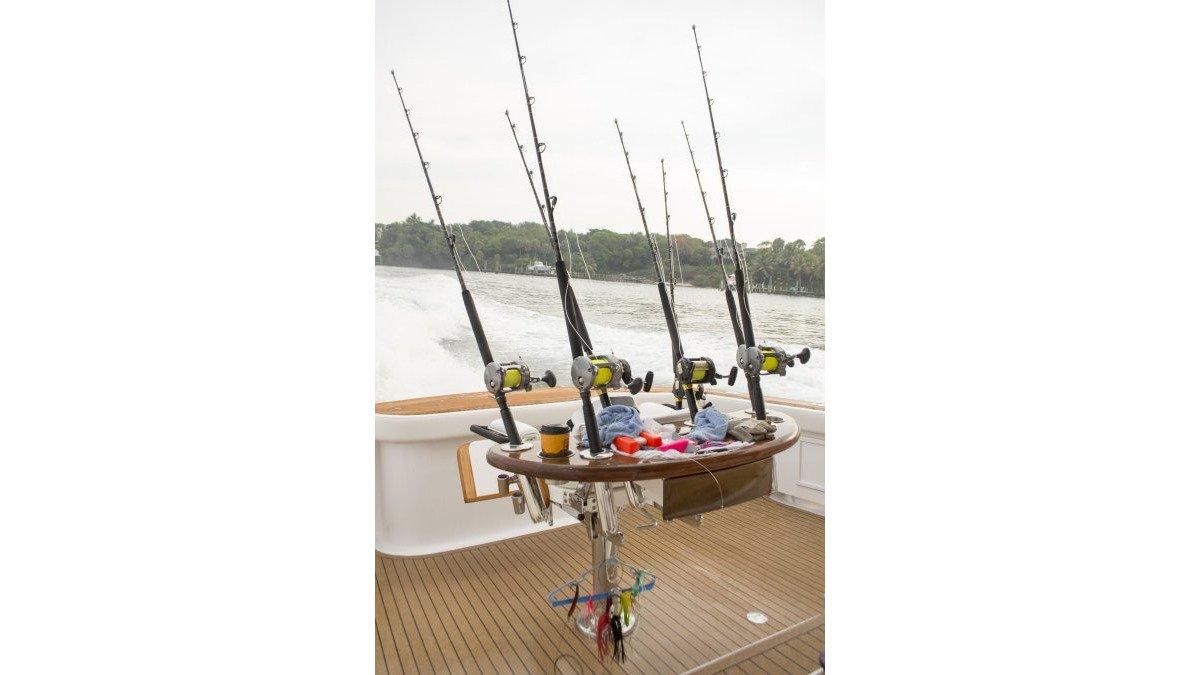
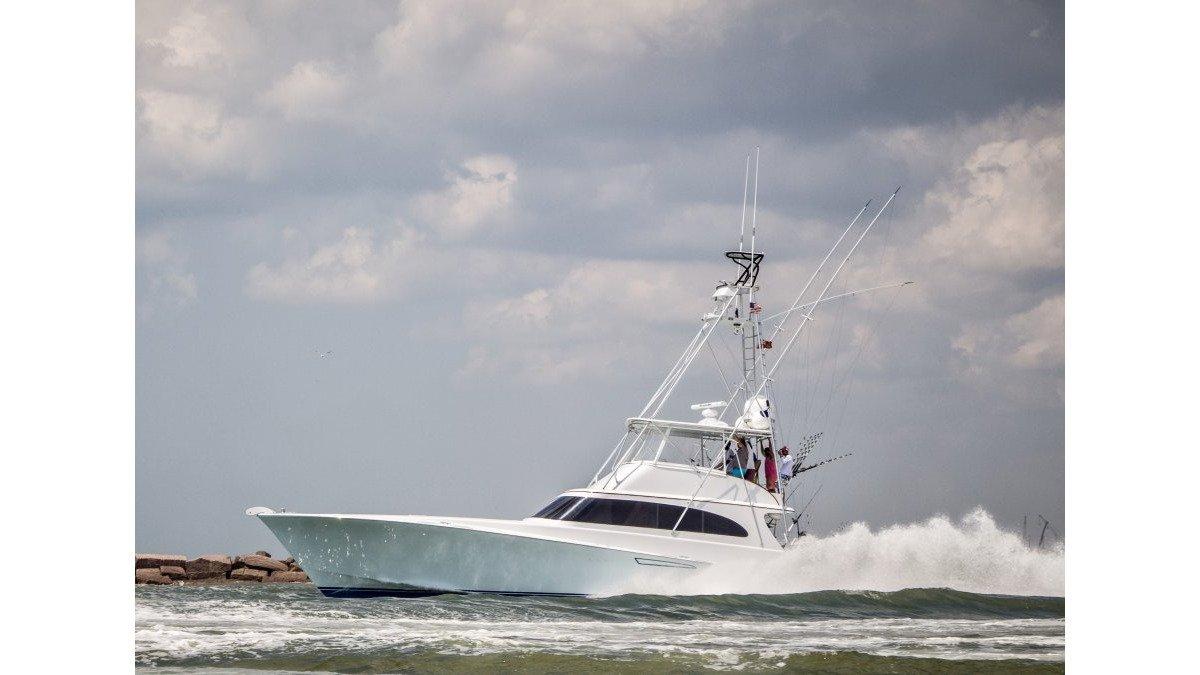
An inboard clears the transom. The shaft and propeller sit under the hull, so the stern can carry a flat covering board, a transom door, a livewell, a fish box, and a fighting chair or rocket launcher without a bracket or a powerhead in the way. That clean stern is why so many offshore convertibles are inboards: an angler can lead a fish to the transom door, wire it, and bring it aboard without working around a lower unit.
An outboard puts hardware on the transom. A single outboard occupies the center of the stern; a twin or triple rig spreads across it. That changes boarding, swim-platform access, and how you fight a fish that runs under the stern. Builders solve this with brackets that set the engines aft of the transom, which restores cockpit space but adds length and moves weight aft. Livewells and fish boxes still fit, but placement has to be planned around the rigging and the engine wells.
Draft is the local limit that general guides ignore. Around Stuart, the St. Lucie Inlet and the sandbars and shoals inside it reward a vessel that can lift its running gear. An outboard trims up and runs shallower, which opens the flats, the back-country creeks, and the shallow launch areas along the Treasure Coast. An inboard's shaft, strut, and propeller sit below the hull and cannot be raised, so it needs more water to run, anchor, and access skinny water.
Match the configuration to how you actually fish. If your season is built around flats and nearshore runs out of the St. Lucie Inlet, an outboard's shallow draft and clean transom access matter more than a few decibels of quiet. If your fishing is offshore, where a steady platform and a clear stern for a fighting chair carry the day, an inboard's layout usually wins. The right answer is the one that fits the water you run and the way you work the cockpit, not the one that wins a spec sheet.
Start with how you fish. If you work shallow flats and want easy service, an outboard configuration fits well. If you run offshore and value a steady, quiet ride with a clean transom, an inboard is often the better match. Next, look at the specific hull. Engine choice is tied to how the boat was designed, so a model built for one configuration rarely converts cleanly to another.
Then compare the total ownership picture, not only the purchase price. Consider fuel use, routine maintenance, saltwater corrosion control and the cost of a major repair. Both configurations can perform well, and disappointment often comes from a mismatch between the engine and how the boat is actually fished. If you are narrowing a search, our Yacht Brokerage team can walk through the options with you against your actual fishing plan.
Standing by to walk through specific vessels with you.
Neither layout is reliable by default. Reliability depends on maintenance history, engine hours, how well the engine was installed, and how often the boat is run in saltwater. Outboards have fewer interconnected systems, such as no separate exhaust or cooling hardware inside the hull, which can make some problems simpler to diagnose and service. Conventional inboards carry more hidden components that need regular attention, but a well-maintained inboard can run for many years. Ask for service records and an engine survey before deciding.
Lifespan varies widely with use, care and the specific engine. Outboards are often replaced or repowered on a schedule because they are easier to swap, while inboards are typically rebuilt rather than replaced. Neither type lasts longer by default. Saltwater exposure, flushing after each trip and consistent oil and impeller service matter more than the layout. Compare engine hours and documented maintenance when evaluating a used sportfish yacht.
Inboards take up space in the engine room and often limit transom and cockpit layout, which can reduce fishing deck area. Access for service can be tight, and some repairs require removing components. Inboards also add exhaust and cooling systems that need saltwater-specific maintenance. Their trim and draft characteristics can make shallow-water access more restricted than with outboards. For many anglers the trade-off is quieter, smoother running in exchange for less deck space and higher service complexity.
Outboards generally leave more usable cockpit and transom space because the engines hang off the stern rather than occupying the engine room. That open transom supports fishing chairs, bait prep and tackle storage. Inboard and inboard-outboard setups place mechanical components in or near the aft deck, which can reduce usable space. Exact layouts vary by hull, so compare deck plans rather than relying on engine type alone when shopping for a sportfish yacht.
 Blog
Compare Bahamas marinas for new yacht owners by slip capacity, location and facilities, and learn what to check before you choose a dock.
 Blog
Setting up crew payroll starts with clean contracts and correct tax treatment. Learn the setup steps and records to keep.
 Blog
Center console boats for Bahamas island hopping: compare range, fuel capacity, and offshore features to choose the right vessel for Gulf Stream crossings.
Send them over. Every inquiry gets a substantive response within 24 hours, from a person who has read what was asked.