 Blog
How to Evaluate Yacht Brokerage Marketing Strategies
Evaluate yacht brokerage marketing with a practical scorecard covering listings, photography, and attribution. Learn the questions to ask before you sign.
Last Updated: November 9, 2026
Quick Summary
The best center console boat for Bahamas island hopping is the one whose verified fuel capacity, consumption, draft, and deck layout match your actual route. Range depends on usable fuel, cruising speed, load, and sea state, so confirm those figures before buying. Plan each fuel stop with a substantial reserve.
Build range from verified consumption at your expected cruising speed, not advertised top speed.
Arrive at each fuel stop with a substantial share of usable capacity remaining.
Confirm fuel stop availability and hours of operation before departure.
Plan the Gulf Stream crossing around a settled forecast rather than a fixed date.
Sea trial and survey any candidate before closing.
Best Center Console for Bahamas Island Hopping: Top Picks
The best center console boat for bahamas island hopping is the one that balances offshore capability with the range, fuel capacity, and onboard comfort your route requires. At Spencer Christopher Yacht and Ship, we treat the choice as a mission-fit decision, not a contest to find the fastest vessel. A center console is an open-deck vessel with a helm positioned near the center, leaving access around the cockpit for fishing and movement.
For island hopping, that open layout can work well for day trips, fishing, and shallow-water stops. But speed and shallow draft do not make a vessel self-sufficient. The practical test is whether its fuel capacity, sea handling, storage, and safety equipment suit the crossings and time aboard you have planned. If you are unsure how a given hull measures up against that test, Spencer Christopher Yacht and Ship's yacht brokerage can help you compare candidates against your actual route.
The real difference between a capable day vessel and a reliable island-hopping choice is the margin it gives you when conditions or plans change.
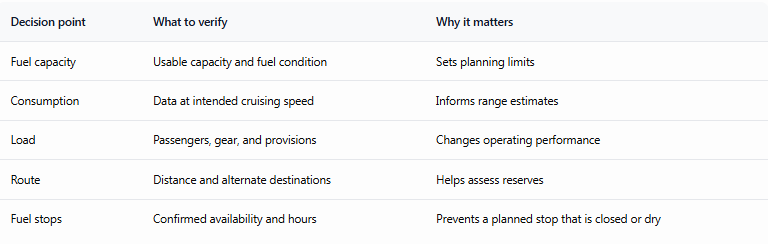
A center console range for Bahamas crossing depends on usable fuel, cruising speed, load, sea state, and reserve planning. A published fuel capacity alone does not establish range: the same vessel may burn fuel differently as load and conditions change. Ask for documented performance data, then assess it against your intended route and operating plan.
Fuel capacity is a planning limit, not a guarantee of distance. Confirm the specific vessel's usable fuel and consumption figures with its documentation and qualified marine professionals.
The distance between fuel stops after you clear Bahamian customs is where range planning lives.
Reserve: Plan to arrive at each fuel stop with a substantial share of usable capacity remaining. That reserve is what buys you the option to divert for weather or hold offshore when a squall line moves through.
Fuel burn varies with load, sea state, and cruising speed. Run the numbers for the specific vessel, and compare the planning range, with reserve, load, and sea conditions factored in, against your longest leg rather than the theoretical maximum.
The Gulf Stream crossing is where range planning meets weather planning. Build the crossing around a settled forecast and plan the return on a separate weather window rather than assuming a fixed date.
Build the plan around the weather, not the calendar.
For a center console range for Bahamas crossing, calculate from verified consumption at the speed you expect to run, not the advertised top speed. Include a reserve, identify fuel stops before departure, and confirm hours of operation. A published range figure is not a route plan on its own.
The best center console boat for Bahamas island hopping is not a single model, it is the vessel whose fuel burn, draft, and deck layout match the route you actually intend to run. Length alone tells you little about Bahamas capability. What separates a capable pick from a compromised one is usable fuel, deadrise at the transom, and how the cockpit is laid out for a full day with passengers and gear.
The four platforms below come up repeatedly in buyer research and owner discussion. Treat each as a starting point for a sea trial, not a verdict.
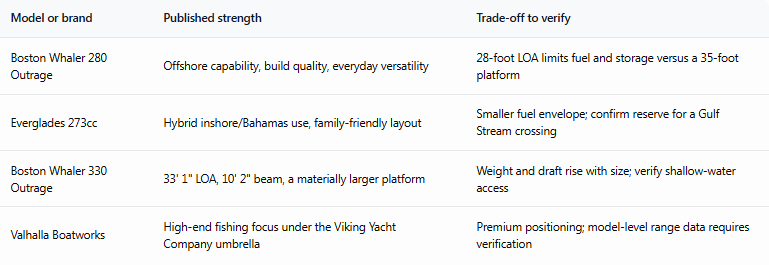
The limitation is physical: a smaller hull has a smaller fuel and dry-storage envelope than a 35-foot platform, so the crossing plan has to be built around shorter legs and confirmed fuel stops.
Pros: Versatility, resale strength, and a hull that handles confused Gulf Stream seas predictably. Cons: Confirm usable fuel and loaded consumption for the specific vessel before planning an Abacos or Exumas run.
A hybrid inshore-and-offshore layout can be attractive if one vessel needs to cover both kinds of days. The 27-foot class is where the inshore-versus-offshore compromise is sharpest, you gain shallow-water access and lose fuel capacity and ride comfort in a head sea.
Cons: Verify fuel capacity and reserve against the longest leg of your intended route.
A larger platform generally offers more cockpit space and stability at rest, at the cost of weight, draft, and fuel burn at cruise, so verify those figures for any model you consider.
Cons: Confirm draft against the shallowest water you intend to enter, and confirm fuel burn at your planned cruise speed.
For buyers prioritizing fishing capability, assess the individual vessel, fuel, electronics, ground tackle, and safety gear, rather than relying on brand positioning.
Cons: Model-level range and crossing details require verification against your route.
Check fuel and draft numbers against the actual route before committing to a model. A small center console that suits a day on the water may not leave enough reserve for a multi-island itinerary if its usable fuel is limited.
Center console boats under 35 feet can suit day use and shorter outings, but buyers should scrutinize fuel capacity, storage, and offshore margin before planning extended island hopping. A smaller vessel may be easier to handle and more versatile near shore; it does not automatically offer the reserves or cabin amenities of a larger platform.
Models of this size can be worth evaluating, but confirm each vessel's exact Bahamas range directly.
Our view: choose the smallest vessel that meets the route and comfort requirements with a credible reserve. Do not let trailerable convenience outweigh the crossing profile. A 2021 Boston Whaler 350 Realm listing can help illustrate a larger model near this threshold; see its specifications and listing details.
A Bahamas-ready center console needs verified offshore performance, suitable fuel capacity, dependable navigation equipment, and safety gear matched to the voyage. The hull, outboard motors, and load matter as much as the model name. Ask for service records and confirm equipment operation during the inspection.
Review these items on the specific vessel:
Range: Confirm usable fuel and consumption at planned cruising speed.
Hull and ride: Assess hull deadrise, trim tabs, and offshore handling with a qualified captain.
Navigation: Check the GPS chartplotter, marine electronics, and autopilot.
Safety: Verify the vessel's safety equipment with qualified guidance.
Practical use: Inspect livewell capacity, dry storage, bow seating, and corrosion resistance.
A common mistake is treating a long equipment list as proof of readiness. Fit, condition, and working order matter more than a brochure's feature count.
A center console yacht inspection checklist should connect the vessel's condition to the route you plan to run. Start with records, then inspect systems and equipment, and finish by confirming performance through qualified review. A survey and sea trial help assess different questions; neither should be replaced by a walk-through alone.
Use this checklist when comparing candidates:
Match fuel capacity and documented consumption to the intended route.
Review maintenance records for engines and onboard systems.
Inspect hull, transom, and visible fittings for damage or corrosion.
Test navigation electronics and safety equipment with a qualified professional.
Check storage, seating, and cockpit layout against passenger needs.
Arrange an independent survey and sea trial before closing.
This is where a broker's role should be practical: surface questions, organize transparent transaction steps, and keep the buyer's interests central. Spencer Christopher Yacht and Ship describes its brokerage as providing fiduciary care from first showing through delivery, with an in-house closing department.
A walkthrough is most useful when it tests the vessel against a defined route and use case, rather than repeating the listing description. Bring your intended passenger load, fishing plans, and crossing priorities. Then compare the vessel's records, equipment, and layout against those needs.
Spencer Christopher Yacht and Ship is an independently owned brokerage serving buyers and sellers of center consoles, sportfish yachts, and superyachts. Its brokers include USCG captains, former crew, engineers, and mechanics, with more than four decades of cumulative experience. A center console can be an excellent island-hopping platform, but the right choice is the vessel whose verified range, condition, and equipment fit the voyage.
Center consoles of varying sizes can be considered for Bahamas island hopping, and the right size depends on your route and fuel needs. Fuel capacity matters as much as hull size, since more usable fuel gives you more room to avoid relying on fuel stops in the islands.
The right size depends on your route, fuel reserve, and crew size, and should be checked against the specific vessel's documented capabilities. Smaller vessels can cross, but they leave less margin for sea state and range. Check your planned route, your fuel reserve and your crew size before settling on a length.
Customs and Immigration entry requirements apply on every entry into the Bahamas, so confirm current fees and requirements with the official authorities before departure, since clearance rules can change. Clearance logistics are one of the areas where small-boat crossings often need the most planning.
A properly equipped, offshore-capable center console can make the Gulf Stream crossing from Florida. Crossing conditions depend heavily on sea state and wind against current, so weather window analysis before departure is essential. Confirm your navigation, safety and communication equipment is in order before you commit to the crossing.
 Blog
Evaluate yacht brokerage marketing with a practical scorecard covering listings, photography, and attribution. Learn the questions to ask before you sign.
 Blog
Marine technical vetting for private yachts goes beyond a survey. See what a vetting inspection covers and how it differs from a marine survey.
 Blog
Viking vs Hatteras sportfish comparison for 2026: offshore performance, resale value, and what to inspect before you buy a used yacht.
Send them over. Every inquiry gets a substantive response within 24 hours, from a person who has read what was asked.