

Table of Contents
Last Updated: September 22, 2026
Steps to Buying a Luxury Yacht: The Process at a Glance
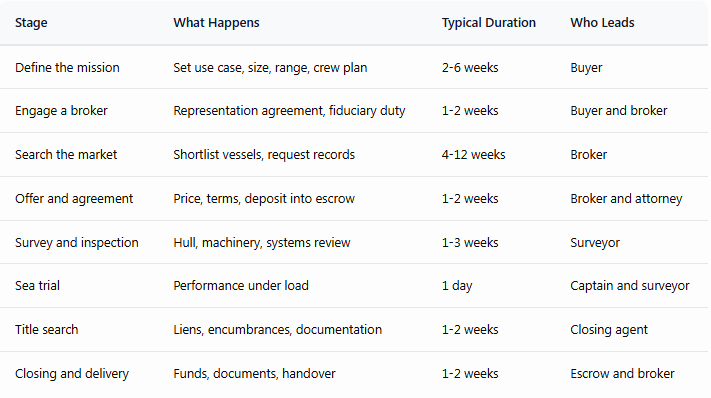
The steps to buying a luxury yacht follow a defined sequence: define the mission, engage a broker, search the market, negotiate an offer, survey the vessel, run a sea trial, verify title, and close through escrow. Each stage protects a different part of your position; skipping one transfers risk.
What Changes When the Vessel Is a Superyacht
A superyacht purchase adds layers a center console or 45-foot sportfish does not carry: classification society records, flag state registration, crew employment obligations, and a formal yacht management structure. The purchase and sale agreement is negotiated by maritime attorneys on both sides.
Define the Mission Before You Shop
The most expensive mistake in buying a luxury yacht is shopping before you know what the vessel must do. Mission drives every specification that follows.
Vessel Specifications That Decide the Deal
LOA (length overall) is the vessel's full length from bow to stern, and it drives dockage, haul-out capacity, and crew requirements. Beam determines interior volume and stability. Draft decides which waters you can enter and which you cannot.
How to Conduct a Marine Vessel Title Search
A marine vessel title search confirms who owns the vessel, what liens or encumbrances attach to it, and whether the seller can transfer clear title. It runs through the U.S. Coast Guard National Vessel Documentation Center for documented vessels and state records for state-titled vessels.
Watch Out A vessel with an unresolved preferred ship's mortgage cannot close cleanly. If the abstract shows a mortgage that the seller has not arranged to satisfy at closing, pause the transaction until escrow instructions address it in writing.
Luxury Yacht Marine Survey Checklist
A pre-purchase marine survey is an independent condition assessment performed for the buyer, not the seller or lender. It produces the report that drives your final negotiation and insurance underwriting. Budget one to three weeks.
Hull below the waterline, including keel, running gear, through-hulls, and seacocks
Hull above the waterline, deck, superstructure, and all penetrations
Moisture readings across the hull and deck laminate
Main engines, including compression, oil analysis, and hours against service records
Generators and auxiliary machinery
Fuel, fresh water, and waste systems, including tank condition and plumbing
Electrical distribution, bonding, and corrosion survey
Navigation, communication, and electronics suite
Ground tackle, windlass, and rode
Fire suppression, bilge pumps, and safety equipment
Tender, davit, and stowage hardware
Yacht appraisal to support financing and insurance
Pro Tip Attend the survey and the sea trial in person if you can. A surveyor documents what is found; a captain reads how the vessel behaves. The gap between a clean report and a vessel that runs hot at cruise shows up in the sea trial data, not the written survey.
Yacht Closing and Delivery Process
The yacht closing and delivery process moves funds and title simultaneously through escrow, then transfers possession. A marine escrow agent holds the buyer's deposit and purchase funds, confirms title search results, and disburses only when both sides have performed.
Ownership Structure and Documentation
How you take title is a decision you make before closing, not after. The structure determines registration, taxation, how a lender records its interest, and how liability is contained.
Individual ownership. Simplest to establish. The vessel is titled in your name, and personal liability is not separated from the asset.
Single-member LLC. Common for owners who want liability separation and a clean operating account for dockage, crew, and maintenance. A lender will typically require the operating agreement and may require a personal guaranty.
Multi-member LLC or partnership. Used when ownership is shared. The operating agreement must state how decisions are made, how a member exits, and what happens on death or divorce of a member.
Corporation. Less common for a single vessel, but it appears where the yacht sits inside a broader business structure.
Tax Exposure to Resolve Before Funds Move
Tax treatment surprises owners who did not ask early. Rules differ by state, and the analysis turns on where the vessel is delivered, kept, and used.
Sales and use tax. Many states impose sales or use tax on a vessel purchase, and the rate and the exemption rules vary widely. Some states cap the taxable amount; others do not. Where the sale closes and where the vessel is first used can change the answer.
Property tax. Some jurisdictions assess personal property tax on a vessel annually based on where it is moored or principally kept.
Documentation and registration fees. Federal documentation carries a fee schedule, and state registration carries its own.
Federal excise considerations. A vessel used in certain commercial activity can trigger federal excise tax obligations. This is a question for a tax professional, not a broker.
Financing at Closing
If the purchase is financed, the lender's preferred ship's mortgage is recorded against the documentation, and its title requirements must be satisfied before disbursement. Expect the lender to require a survey, an appraisal, and proof of insurance. The escrow agent coordinates the lender's documents with the bill of sale and Coast Guard transfer forms.
Delivery and Acceptance
Delivery is its own event, separate from closing. Confirm the vessel's location, fuel and water state, and inventory list against the agreement. Walk the vessel with the seller and note discrepancies in writing before you accept. Once you accept, risk of loss shifts to you.
Watch Out Do not schedule delivery before insurance is bound and the lender's documents are executed. A vessel that moves without coverage in force puts the entire transaction at risk.
Key Takeaway Decide ownership structure, registration path, and tax exposure before the purchase and sale agreement is signed. These are not closing-day decisions, and changing them afterward means amending documents that have already recorded.
What the Purchase Price Does Not Cover
The purchase price is the beginning of your cost of ownership, not the end. Running costs accumulate every year regardless of how often the vessel leaves the dock. A realistic model has three layers: fixed annual costs, variable operating costs, and the capital reserve.
Fixed Annual Costs
These arrive whether the vessel runs or sits.
Dockage or moorage, billed by length overall. A slip for a 60-foot vessel costs materially more than one for a 40-foot vessel, and availability in a desirable inlet is its own constraint.
Insurance premiums, based on hull value, cruising area, crew, and owner experience. Premiums scale with agreed hull value, not purchase price alone.
Registration, documentation, and personal property tax, where applicable.
Crew wages, benefits, and payroll obligations if the vessel carries crew. A captain and one steward represent a recurring annual commitment that continues through yard periods.
Management fees, if a professional management arrangement handles crew, compliance, and maintenance scheduling.
Variable Operating Costs
These scale with use, and they are the ones owners underestimate.
Fuel at cruise consumption rates. A vessel burning a given rate per hour at cruise turns a long passage into a significant line item. Range and burn rate are specification decisions with annual cost consequences.
Scheduled engine and generator service, measured in hours against the manufacturer's interval.
Bottom paint, zincs, and haul-out, typically on an annual or biennial cycle depending on the waters.
Tender fuel, maintenance, and replacement on its own cycle.
Consumables, oil, filters, impellers, and the small parts that keep systems running.
The Capital Reserve
Beyond the annual numbers sit costs that arrive without warning: a failed component found three months after closing, a hull blister repair, an electronics refit, or a tender replacement. These are predictable over a multi-year horizon and should be funded as a line item.
How to Build the Model
Key Takeaway Build a maintenance reserve into your ownership budget from day one. Owners who treat the reserve as a line item, not a contingency, are the ones who keep their vessels in survey condition and hold resale value.
Spencer Christopher Yacht and Ship handles the full sequence, from first showing through final delivery, with an in-house closing department and brokers who have run these vessels themselves. Our team holds a Certified Professional Yacht Broker credential, a U.S. Coast Guard 100-gross-ton Master license, and membership in the International Yacht Brokers Association. We represent buyers and sellers across the Eastern Seaboard and the Bahamas.
Frequently Asked Questions
What are the steps involved in buying a luxury yacht?
The sequence runs: define the mission and budget, retain a broker, search and inspect vessels, make an offer under a purchase and sale agreement, conduct a marine vessel title search, commission a pre-purchase survey and sea trial, negotiate the findings, then close through escrow and take delivery. Each stage protects the next. Skipping the title search or survey to save time is the most common and most expensive shortcut buyers take.
How does a marine vessel title search protect a buyer?
A title search confirms the seller actually owns the vessel free of competing claims. It checks the U.S. Coast Guard documentation database, state registration records, and UCC filings for liens from lenders, yards, or equipment suppliers. Without it, a buyer can close on a yacht and inherit a debt secured against it. The search is run before funds move into escrow, not after.
What is the role of a yacht broker in a luxury transaction?
A fiduciary broker represents your interest, not the seller's. That means running comparables before you offer, coordinating the survey and sea trial, reading the purchase and sale agreement line by line, and telling you when a vessel is a bad deal. Spencer Christopher Yacht and Ship staffs brokers who are USCG captains, former crew, and engineers, so inspection findings get caught before closing rather than three months after.
Why is a professional marine survey critical before closing?
The survey is your only independent look at hull material, moisture, structural grid, engines, generators, and systems. A surveyor reports condition and fair market value, which gives you leverage to renegotiate or walk away. Buyers who waive the survey to win a bidding war often absorb repair costs that exceed what they saved on the price. Always attend the haul-out if you can.
What should a buyer expect during a sea trial?
A sea trial runs the vessel under load: full throttle, cruise RPM, and maneuvering in tight quarters. The captain and surveyor log top speed, fuel burn, vibration, exhaust color, and engine temperatures against the vessel specifications. It is also where you test the tender launch, windlass, electronics, and generator under demand. Insist on a sea trial before the survey contingency expires.
What does the yacht closing and delivery process involve?
Closing moves funds through a marine escrow agent while the bill of sale, title transfer, and lien releases are executed. Once funds clear, you receive the documentation, the vessel is delivered, and a captain can run the handover covering systems, ground tackle, and safety gear. Confirm insurance is bound before the yacht leaves the dock, since coverage rarely transfers automatically.
Questions this raised for you?
Send them over. Every inquiry gets a substantive response within 24 hours, from a person who has read what was asked.